


Table of Contents
- Best Fly Control for Horse Barns: Quick Comparison
- How to Choose Fly Control for Horse Stalls
- Automatic Spray Systems: The Set-and-Forget Option
- Metered Dispensers and Foggers for Smaller Barns
- Horse Barn Fly Traps and Bait Stations That Work
- Manure Management for Fly Control: Fix the Source First
- Fly Predators for Horse Manure: What They Can and Can't Do
- Which Fly Control Setup Fits Your Barn?
- Frequently Asked Questions
Last Updated: October 18, 2026
Best Fly Control for Horse Barns: Quick Comparison
Flies are the one barn problem that never takes a day off. At Air Capital Tack, we've spent decades around horses in Derby, KS, and we know that the best fly control for horse barns is never one product. It's a system: something knocking down adults, something stopping the next generation, and something cutting off the breeding ground.
Below, we break down eight proven approaches and match them to real barn setups. We'll show you what each costs, what it does well, and where it falls short.
| Method | Best For | Upfront Cost | Effort Level |
|---|---|---|---|
| Automatic spray system | 4+ stall barns | $1,999.99 | Set-and-forget |
| Metered dispenser | Small barns, stalls | $41.99 | Low |
| Fogger | Quick knockdown | $25.99 | Occasional |
| Baits and traps | Population knockdown | $16.99-$54.99 | Low |
| Manure management | Every barn | Varies | High |
| Fly predators | Pasture-side manure | Varies | Moderate |
How to Choose Fly Control for Horse Stalls
Start with barn size, then work backward. A four-stall setup and a twenty-stall facility need completely different tools, and buying the wrong scale wastes money fast.
Ask three questions before you spend a dollar. How many stalls are you covering? How much daily labor can you commit? And where are flies actually breeding on your property?
Automatic systems suit larger barns where labor is short. Metered dispensers and foggers fit smaller operations. Bait and traps work anywhere but need placement discipline.
One rule we've learned: spend on source control before you spend on sprays. A spray system over a wet, matted manure pile is money poured into a losing battle.
Automatic Spray Systems: The Set-and-Forget Option
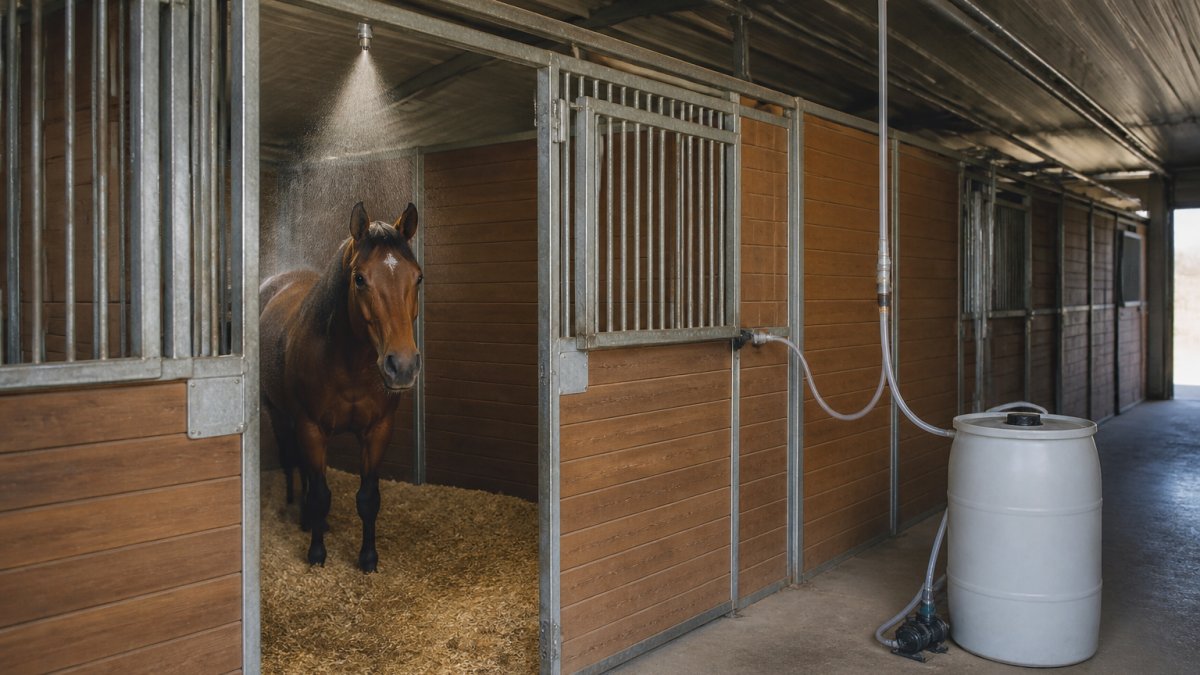
Automatic spray systems are the closest thing to hands-off fly control for horse stalls. A programmable timer releases a fine mist through mounted nozzles on a set schedule, covering the barn even when you're away.
The Pyranha SprayMaster Kit is our top pick for a four-stall barn. It includes a 55-gallon drum, motor, timer, pump, 8 nozzles, and 160 feet of tubing. Each nozzle covers a 12' x 12' area, and at the recommended setting of five 45-second sprays per day, the kit lasts about five months. It ships free, though allow extra days for the size. It runs $1,999.99.

Refills use the Pyranha 1-10 HP Concentrate, a pyrethroid formula built for automatic systems. It kills and repels horn, deer, horse, stable, and face flies, plus midges and mosquitoes. A 2.5-gallon jug runs $240.99. Note it's not available in residential misting systems in New York.
Pros: Coverage while you're away, consistent dosing, expands with additional nozzle kits. Cons: High upfront cost, needs installation, best suited to larger barns.
Metered Dispensers and Foggers for Smaller Barns
Metered dispensers deliver timed bursts of aerosol insecticide, and they're the budget-friendly answer for small barns and individual stalls. The Country Vet Q-Mist Kit runs $41.99 and includes the dispenser plus one can of fly spray. It controls flies, mosquitoes, and moths and runs quietly on two D batteries (not included).

Refills are simple: the Country Vet Metered Fly Spray Refill ($12.99) provides up to 30 days of automatic control per 6.4 oz can. It kills flies, gnats, and small flying moths using pyrethrins from chrysanthemum flowers.
For fast knockdown between treatments, a fogger earns its shelf space. The Prozap LD-44Z Insect Fogger ($25.99) contains 0.5% pyrethrin and 4% PBO and knocks down flying and crawling insects in barns, stables, and kennels. It's a treatment, not a system, so use it to clear a space, not to maintain it.
Horse Barn Fly Traps and Bait Stations That Work
Baits and traps knock down adult fly populations fast, and they're the easiest add-on to any barn fly control plan. The trick is placement and rotation, since flies adapt to a single bait over time.
QuikStrike Fly Scatter Bait ($16.99 for 1 lb) uses dinotefuran to control house flies, including those resistant to organophosphates and carbamates. It contains Z-9 tricosene as an attractant and works as a scatter bait or in a station.
Quikbayt Fly Bait ($54.99 for 5 lb) is a pelleted bait with 0.5% imidacloprid for flies resistant to older chemistries. It includes muscalure as an attractant and Bitrex to discourage ingestion by children and pets, so keep it out of reach.
Both baits belong where flies congregate, not where horses feed. Keep stations away from feed rooms and water troughs.
Pyranha - SprayMaster Insecticide Spray Kit →
Pros: Cheap, fast knockdown, easy to deploy. Cons: Requires rotation, must be kept from pets and kids, targets adults only.
Manure Management for Fly Control: Fix the Source First
Manure management is the single most effective fly control step in any barn, and it's the one most owners skip. Flies breed in moist, undisturbed manure and bedding, so removing that material breaks the life cycle at its source.
The routine is unglamorous but simple. Strip stalls daily or every other day, haul manure well away from the barn, and keep piles dry and turned. Wet bedding around waterers and wash racks deserves the same attention.
A premise spray adds residual protection to surfaces. Martin's 10% Permethrin ($12.99 for 32 oz) provides knockdown and residual activity for up to 28 days on barns, stables, and animal housing. Pyranha Stock Guard Concentrate ($16.99) dilutes for premise spraying and livestock use, with one 8 oz bottle making 6 to 25 gallons depending on application.

Fly Predators for Horse Manure: What They Can and Can't Do
Fly predators are tiny parasitic wasps that lay eggs inside fly pupae, killing the next generation before it emerges. They're a biological tool, not a spray, and they work best as part of a broader plan.
What they can do: reduce fly emergence in manure piles and pasture-side breeding areas over time. What they can't do: rescue a barn with an active infestation, replace manure removal, or work well if you spray insecticides indiscriminately over the release areas.
Release predators near breeding sites, not inside stalls. Follow the supplier's timing and quantity guidance, and give the program several weeks before judging results. Predators reward patience and consistency.
Pros: No chemicals, targets breeding cycle, safe around horses. Cons: Slow to show results, sensitive to chemical sprays, needs ongoing releases.
Which Fly Control Setup Fits Your Barn?
The right setup depends on scale and labor. Here's how we'd match it:
- Two to four stalls, limited staff: Country Vet Q-Mist Kit plus baits and strict manure removal.
- Four to twelve stalls: Pyranha SprayMaster Kit with 1-10 HP refills, plus QuikStrike or Quikbayt stations.
- Large facility: SprayMaster expanded with extra nozzle kits, a fogger for knockdown, premise sprays, and a fly predator program.
- Pasture-heavy operation: Manure management and fly predators first, with premise spray on structures.
Whatever you choose, buy from a source that knows horses. Air Capital Tack has served Derby, KS and the surrounding area since 2021, backed by over 42 years in the equine industry, and we ship six days a week so your fly control doesn't wait. If you're searching for reliable fly control near me, our team can match products to your barn's size and layout.
Frequently Asked Questions
What is the most effective fly control for a horse barn?
No single product handles every fly. The most effective approach combines an automatic spray system, such as the Pyranha SprayMaster Kit at $1,999.99 for a four-stall barn, with bait stations and consistent manure removal. Spray systems knock down adult flies in stalls, baits target house flies, and cleaning breaks the breeding cycle in manure and wet bedding. Owners who stack two or three methods usually see far fewer flies than those relying on spray alone.
How do you keep flies out of a horse barn?
Start with airflow and sanitation. Remove manure and soiled bedding daily, keep feed and water areas dry, and use fans to move air through stalls. Then add a control layer: an automatic misting system for stalls and aisles, scatter bait such as QuikStrike for house flies, and fly traps placed near doors and along aisles. Seal or screen openings where possible. Physical exclusion plus source reduction does more than any single spray.
Where should you place fly traps around a horse barn?
Place traps where flies gather but horses do not spend time: near exterior doors, along aisle walls, and close to manure storage. Keep traps at least several feet from stall fronts and feed areas so trapped insects do not draw more flies toward horses. Check and empty traps regularly, because a full trap stops working and can become a breeding site itself. Rotating trap locations every few weeks helps catch flies that learn to avoid one spot.
Do fly predators work in horse barns?
Fly predators are tiny parasitic wasps that lay eggs in fly pupae, and they can help reduce fly populations when used consistently. They work best as part of a full program alongside manure management, not as a standalone fix. Release them near manure piles and wet bedding, follow the supplier's release schedule, and avoid spraying insecticides directly on release areas. Expect gradual improvement over a season rather than immediate knockdown.
How often should you clean a horse stall to reduce flies?
Remove manure and wet bedding at least once daily, and strip and rebed stalls weekly or as needed. Flies complete their life cycle in as little as seven to ten days in warm weather, so manure left in place for a week can produce a new generation. In summer, pick stalls twice daily if possible, keep dumpsters and manure piles away from the barn, and fix any leaks that keep bedding damp.
Flies will always find a barn. The question is whether your setup stops them at the door or lets them breed in the aisle. Air Capital Tack carries the full range of fly control tools, from the Pyranha SprayMaster Kit and 1-10 HP refills to baits, foggers, and premise sprays, all curated by people who've spent decades in the equine industry. Get started with Air Capital Tack and build a fly control plan that fits your barn, your budget, and your schedule.


