


Last Updated: November 8, 2026
Quick Summary
Western saddles are heavier, with a deeper seat and a horn, suiting ranch work and roping, while English saddles are lighter and flatter for closer contact and jumping or dressage. Choose based on the riding you will actually do in the next 12 months, then confirm fit on your own horse before buying.
- Decide on your discipline first, since buying for a later discipline often means buying twice.
- Western saddles are often heavier, so lift the saddle on and off several times before buying.
- Check that the tree width matches your horse's withers and back shape, and that a hand fits under the front.
- Always test fit with weight in the saddle, because a saddle can look level on a stationary horse and still bridge.
- Budget for the pad, girth, stirrup leathers and any breast collar, not just the saddle.
Table of Contents
- Western vs English Saddles: The Core Differences
- Side-by-Side Buying Checklist for Derby Riders
- English Saddle vs Western Saddle Size: How to Measure
- Are Western or English Saddles Better for the Horse?
- English vs Western Riding for Beginners: Which Is Easier to Learn
- Can a Horse Be Ridden Both English and Western?
- Choosing Your First Saddle at Air Capital Tack in Derby
- Frequently Asked Questions
Western vs English Saddles: The Core Differences
Western and English saddles are built for different riding styles, and choosing between them starts with understanding how each one is made. The short answer: western saddles are heavier, with a deeper seat and a horn, while English saddles are lighter and flatter, designed for closer contact with the horse.
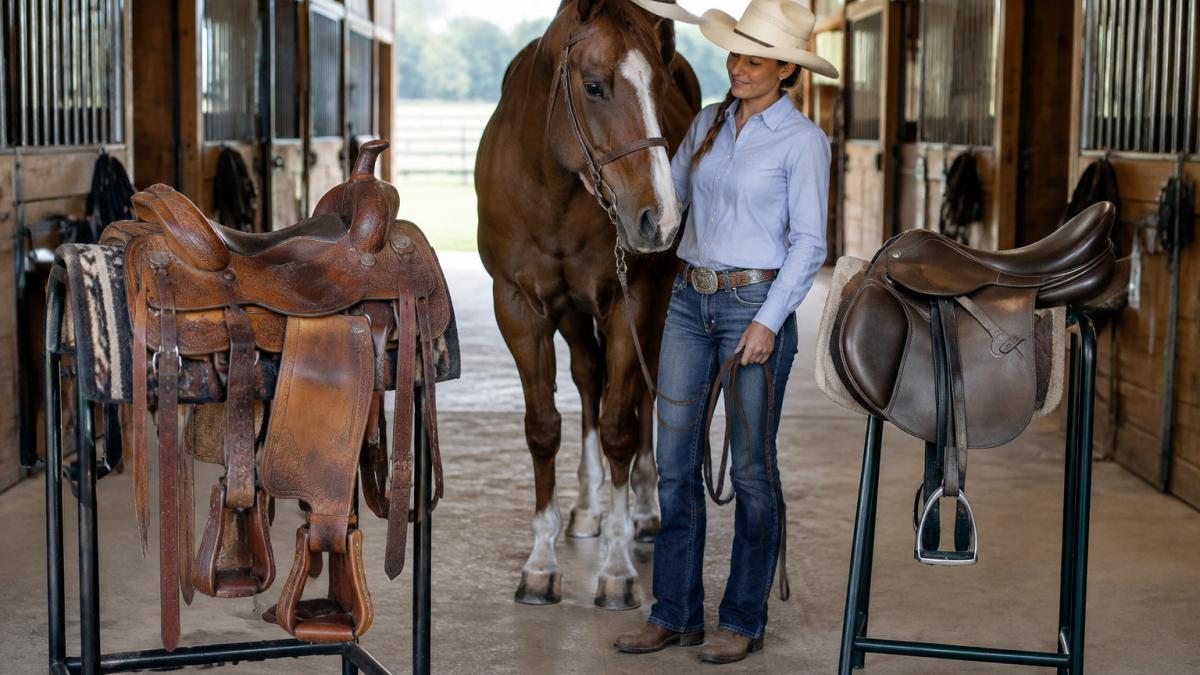
Western saddles generally have a deeper seat and a horn, while English saddles have a flatter seat. Both designs have a purpose, and the right one depends on how you plan to ride.
Construction, weight and seat shape
The biggest physical difference is weight. Western saddles are often heavier than English models, and that added weight can suit riders doing ranch work or roping.
English saddles are generally lighter and sit closer to the horse, with a flatter seat. If you are unsure which weight suits you, our King Series Classic Pony Saddle 12" ($397.99) and Royal King Ridgeline Saddle 15" ($769.99) are available to compare.
Rider position, horn and stirrup design
Western riders generally sit deeper in the saddle, and the horn gives you something to hold.
English riders generally sit more upright and forward, and there is no horn. Neither position is better in general; it depends on what your riding requires.
Watch out: buying a saddle for its look alone can leave you with a seat that doesn't match how you actually ride. Decide on your discipline first.
Side-by-Side Buying Checklist for Derby Riders
A checklist only helps if it forces a decision at each step. Use this one in order, and score each saddle you try against the same criteria so you are comparing like with like.
1. Discipline first, saddle second. Write down the riding you will actually do in the next 12 months, trail riding at Cheney State Park or Sedgwick County Park, ranch work, roping practice, hunter-jumper lessons, or dressage schooling.
2. Rider fit. Seat size, thigh length, and hip width all affect how you sit. Western saddles are commonly sized 14 to 17 inches; English saddles use a similar seat range but feel flatter.
3. Horse fit, the step most buyers skip. Ask these questions before you pay:
- Does the tree width match the horse's withers and back shape?
- Can you slide a hand under the front of the tree without pinching?
- Does the saddle sit level, or does it rock or bridge?
- Does the panel (English) or skirt (western) make even contact along the back?
A saddle that fits the rider but not the horse will cause soreness, behavior changes, and slipping. Have a saddle fitter or experienced trainer check the fit on your horse before you commit.
4. Weight and handling. Western saddles are heavier and bulkier; if you tack up alone, lift the saddle on and off several times in the shop to see whether you can manage it comfortably.
5. Stirrup and tread. Western stirrups are wider and heavier, often with padded treads; English stirrups are narrower and lighter. Match the stirrup to your boots and to how much time you spend standing in them.
6. Attachment points. Western saddles offer D-rings and ties for ropes, bags, and breast collars; English saddles have fewer attachment points but are built for close contact.
7. Budget beyond the saddle. Price the saddle pad, girth or cinch, stirrup leathers, and any breast collar or martingale you need. A saddle that stretches your budget before tack is the wrong saddle.
8. Maintenance. Leather needs cleaning and conditioning; western saddles have more leather and more crevices to maintain. Factor in the time you will realistically spend on care.
Watch out: a saddle that looks right on the rack can sit wrong on your horse, never buy without a fit check on the horse you will ride.
The article's buying checklist lays out the key decisions for each step, so you can compare saddles on the same criteria.
| Step | What to check | Key note |
|---|---|---|
| 1. Discipline | Riding planned for next 12 months | Buying for a later discipline often means buying twice |
| 2. Rider fit | Seat size, thigh length, hip width | Knee should not jam against pommel or horn |
| 3. Horse fit | Tree width, hand clearance, level seat | Have a fitter or trainer check on your horse |
| 4. Weight | Lift saddle on and off repeatedly | Western saddles are heavier and bulkier |
| 5. Stirrups | Match width, weight and boots | Western stirrups are wider with padded treads |
| 6. Attachments | D-rings and ties for gear | Western saddles offer more attachment points |
| 7. Budget | Pad, girth, leathers, breast collar | A saddle that exhausts budget is the wrong choice |
| 8. Maintenance | Cleaning and conditioning time | Western saddles have more leather to care for |
English Saddle vs Western Saddle Size: How to Measure
Sizing a saddle means checking your seat measurement and the horse's back. Western saddles are sized by seat length, usually 14 to 17 inches. English saddles use a similar range but feel different because of their flatter profile.
To measure your seat, sit in your normal riding position on a flat surface and measure from the middle of the seat to the front of the pommel or the horn, following your saddle's sizing chart. Use a height and weight tape to get your numbers right before you shop. The Easy Measure Height Weight Tape is a tool for taking those measurements at home.

A saddle that is the right length can still pinch or slide if the tree does not match the horse.
Are Western or English Saddles Better for the Horse?
Neither style is better for the horse by default, fit decides comfort, and fit is about four things: tree shape, gullet width, contact area, and balance.
Tree shape. The tree is the rigid frame that gives the saddle its shape. Western trees are generally wider, and English trees are generally narrower. A tree that does not match the horse's back curve will bridge (contact only at front and back) or rock (contact only in the middle), and both create pressure points.
Gullet width. The gullet is the channel over the withers. It must clear the horse's spine and withers with room to spare. A gullet that is too narrow pinches the shoulders and restricts movement; one that is too wide lets the saddle sit too low.
Contact area and panels. English saddles use stuffed panels to create even contact along the back; western saddles rely on skirts and a wider tree. More contact area generally spreads pressure, which is why heavier western saddles can suit long trail days, but only if the contact is even. A poorly flocked panel or a lumpy skirt concentrates pressure no matter how large the saddle is.
Balance. A balanced saddle sits level and keeps the rider's weight centered over the horse's strongest area. A saddle that tips the rider forward or back changes pressure distribution and can cause soreness over time.
Rider weight and ride length. Heavier riders and longer rides increase load on the horse. A western saddle's larger contact area can help, but it does not cancel out an unfit horse or an unbalanced rider. Match the work to the horse's fitness and build condition gradually.
What to check on your horse:
- Saddle placed correctly, girthed, and ridden for 20-30 minutes
- Sweat pattern even on both sides, with dry spots indicating pressure
- No flinching, tail swishing, or hollowing when the saddle is placed
- Wither and spine clearance maintained with a rider mounted
- Saddle stays centered without constant re-positioning
A saddle fitter or experienced trainer can check these points in person, and it is worth doing before you buy.
Watch out: a saddle can look level on a stationary horse and still bridge once the rider mounts, always check fit with weight in the saddle.
English vs Western Riding for Beginners: Which Is Easier to Learn
Many beginners find western riding easier to start with, since the deeper seat and horn offer more security.
English riding teaches closer contact and more precise cues. Beginners may find the lighter saddle less forgiving at first. Choose based on your goals. If you want to trail ride, western is a natural start. If you plan to jump or show, English builds the skills you will need.
Watch out: beginners sometimes buy a saddle before they have ridden enough to know what they need. Try several saddles, and take a lesson first if you can.
Can a Horse Be Ridden Both English and Western?
Yes. Many horses are ridden in both styles, though you will need the correct saddle, bridle, and girth for each. Switching between them is common among riders who trail ride on weekends and take English lessons during the week. The horse usually adapts well as long as both saddles fit properly.
If you plan to use both, budget for two saddles and fit each one separately. Using one saddle for both disciplines can cause uneven pressure and discomfort over time.
Choosing Your First Saddle at Air Capital Tack in Derby
Choosing your first saddle comes down to discipline, fit, and budget. At Air Capital Tack, our team in Derby, KS can help you compare western and English options in person, and we ship products six days a week for riders who shop online. We have worked with horse owners for over 42 years, so we know which setups suit different riders.
Explore our Western Saddles collection to see the range available to buy, or browse English Saddles to compare the lighter options.
Ready to find the right saddle for your riding? Visit Air Capital Tack in Derby or shop online for a saddle.
Frequently Asked Questions
Are Western or English saddles better for the horse?
Neither saddle is better for every horse. Fit matters more than style: a saddle that sits level, clears the withers and distributes weight across the back is the goal, regardless of type. Western saddles spread weight over a wider area with a larger tree and seat, while English saddles are lighter and sit closer to the horse. Have a qualified fitter check the tree and panel shape against your horse's back before you buy, and watch for signs of pressure such as sensitivity, white hairs or resistance under the saddle.
Can a horse be ridden both English and Western?
Yes. Many horses are trained in both disciplines, but each saddle must fit the horse's back and the rider's position. A horse that moves comfortably in one saddle may need time to adjust to the other because the rider sits and cues differently. Switching gradually, checking the fit of each saddle and paying attention to the horse's back after each ride will help you identify any problem before it becomes a sore spot.
Is it harder to ride in an English saddle?
English saddles require a more active, balanced seat and closer contact with the horse, which many beginners find harder at first because there is less built-in security. Western saddles, with a horn and deeper seat, help a new rider stay centered. Lessons with an instructor who can explain position and balance will make either style easier to learn, and both disciplines build the same core skills over time.
How do you choose the right saddle size for a horse and rider?
Start with the horse's back: a saddle that is too narrow or too wide will pinch or rock. Rider size and riding style also influence the seat size you need, since a western seat is usually measured in inches while English seats are typically described in inches or by length. Test the saddle with the rider mounted, check that there is room over the withers and that the seat leaves the rider centered, and ask a qualified saddle fitter to help you narrow down the options.


