


Last Updated: November 5, 2026
Quick Summary
Leather tack needs conditioning because its fibers rely on internal oils to stay flexible, and riding, sweat, grit, and weather steadily strip those oils out. Conditioning replaces what is lost, which is the core reason why leather tack needs conditioning: it keeps the fiber structure intact and prevents cracking at the stress points.
- Sweat salts pull moisture out of leather and leave a crust as they dry, repeating with every ride.
- Dry leather cracks first at the billet, bridle cheek, and stirrup leather, where it bends most.
- Clean tack before conditioning so the product bonds to a clean surface instead of trapped dirt.
- Run the bend, feel, and water-drop checks to decide whether leather is ready for conditioner.
- Patch test any product and avoid over-conditioning, which leaves leather greasy and weakens stitching.
Table of Contents
- Why Leather Tack Needs Conditioning in the First Place
- How Sweat, Dirt, and Moisture Dry Out Leather
- How to Clean Horse Tack Before You Condition It
- A Simple Test to Tell When Your Tack Is Dry
- Choosing Between Saddle Soap, Neatsfoot Oil, and Conditioner
- How Often to Condition Leather Tack in Derby's Climate
- Conditioning Risks, Product Compatibility, and Safety Checks
- Frequently Asked Questions
Why Leather Tack Needs Conditioning in the First Place
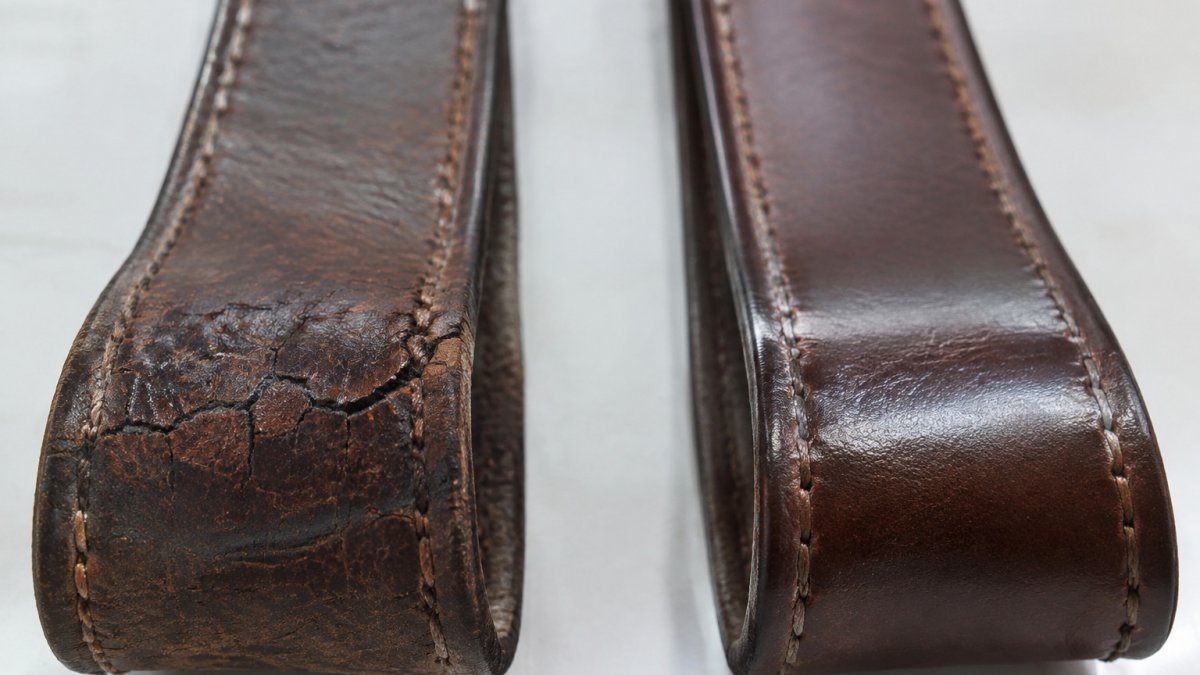
Leather is not a dead, static material. It is a network of collagen fibers that were stabilized during tanning, and those fibers are kept sliding past one another by a mix of oils and fats worked into the hide, often called fatliquor. That internal lubrication is what lets a billet bend around a roller and a bridle cheek flex at the bit without the surface splitting.
Every ride spends that lubrication. Sweat carries salts into the grain, sun and dry air pull moisture out, and grit grinds the surface. As the fatliquor depletes, the fibers stop sliding and start abrading against each other. The leather stiffens, fine lines appear at the bends, and eventually the surface cracks where the flex is greatest. Keeping the fibers supple through timely conditioning helps limit the stress that leads to cracks, and the same principles apply when preventing leather cracks in holsters.
Conditioning replaces what use and weather remove, and it is the core reason why leather tack needs conditioning: it is not a shine step, but the maintenance that keeps the fiber structure intact.
Here is what is actually at stake:
- Flexibility at the stress points. Dry leather cracks first at the billet, the bridle cheek, and the stirrup leather, the places that bend every ride.
- Tensile strength. Leather that loses its internal oils weakens, and the load then shifts onto stitching and hardware. A dry billet can fail before the stitch line does.
- Comfort and fit. Supple leather conforms to the horse instead of rubbing, which matters most on girths and breastplates that sit under pressure.
- Service life. A well-conditioned saddle or bridle can stay in safe working rotation for years longer than one that is cleaned only when it looks dirty.
Leather keeps changing with use, sweat, and weather. Conditioning is how you keep pace with those changes instead of reacting after a strap has already gone brittle.
How Sweat, Dirt, and Moisture Dry Out Leather
Sweat is the biggest enemy of leather tack. Horse sweat contains salts that pull moisture out of the leather and leave behind a crust as it dries. Each ride repeats that cycle.
Dirt and grit work like sandpaper. When dust settles into the grain and gets worked in by the saddle or girth, it wears away the surface and the oils underneath.
Moisture cuts both ways. Rain and humidity can soften leather and encourage mildew, but repeated soaking followed by fast drying pulls oils out of the fibers. Heat from direct sun or a heated tack room speeds this up even more.
Dirt left on the surface also blocks conditioner from soaking in. That is why cleaning comes before conditioning.
How to Clean Horse Tack Before You Condition It
Cleaning first gives the conditioner a clean surface to bond with. Skipping this step traps dirt and old product under a new layer.
- Remove loose dirt. Wipe the tack with a dry cloth or soft brush.
- Dampen a sponge. Use lukewarm water, not soaking wet.
- Apply a small amount of saddle soap. Work it into a lather in circular motions.
- Wipe off the lather. Use a clean, damp cloth to remove all residue, including in crevices and stitching.
- Let the tack air dry. Keep it out of direct sun and heat. Do not rush it with a heater.
Fiebing's Saddle Soap works well for this step and is sold at Air Capital Tack for $9.99. Tack cleaners are also available to browse on our site if you want a full set. Browse our tack cleaners

A Simple Test to Tell When Your Tack Is Dry
Not sure whether your tack needs conditioner? Try this quick check:
- Bend test: Gently bend a section of the leather, such as the flap near a buckle. Fine surface lines are normal. Deep cracks or a whitish, powdery look mean it is overdue.
- Feel test: Run your thumb over the surface. Dry leather feels rough or chalky. Well-kept leather feels smooth and slightly oily.
- Color test: Faded, grayish areas often signal dryness, especially on the sides of saddles and reins.
- Water drop test: Place a drop of water on the leather. If it soaks in within seconds, the leather is thirsty. If it beads up, the finish is still protected.
If the leather fails two or more of these checks, clean it and condition it before the next ride.
Choosing Between Saddle Soap, Neatsfoot Oil, and Conditioner
Each product does a different job, so the choice depends on what your tack needs.
Wfy One Step Leather Cleaner Cream 15 OZ →
- Saddle soap cleans and lightly lubricates. It is best for routine cleaning and for removing sweat salts. Fiebing's Saddle Soap is a common choice for this.
- Neatsfoot oil penetrates deeply and softens very dry or stiff leather. It can darken leather, so test it first. Lexol Neatsfoot Leather Conditioner is a non-darkening formula, which suits smooth, light-colored leather.
- Leather conditioner adds moisture and a protective layer for everyday use. The Lexol Leather Tack Conditioner, 33.8 Ounces, is sold at Air Capital Tack for $21.99. Wfy One Step Leather Cleaner Cream, 15 oz, at $16.99, is for use on natural and synthetic leather and lifts and removes dirt and sweat.
For most riders, a cleaner followed by a conditioner covers routine care. Save neatsfoot oil for leather that is badly dried out. Explore our leather care options


Each product does a different job, so the best choice depends on what your tack needs.
| Product | Best for | Key difference |
|---|---|---|
| Saddle soap | Routine cleaning and sweat salts | Cleans and lightly lubricates |
| Neatsfoot oil | Very dry or stiff leather | Penetrates deeply but can darken leather |
| Leather conditioner | Everyday moisture and protection | Adds moisture and a protective layer |
| Non-darkening neatsfoot (Lexol) | Smooth, light-colored leather | Softens without darkening |
How Often to Condition Leather Tack in Derby's Climate
Local climate changes through the year, so a fixed 'condition monthly' rule may not fit. Treat frequency as a decision you make from three inputs: how often the tack is used, how much sweat it absorbs, and how it is stored.
Start with a use-and-sweat baseline.
- Light use (a few rides a month, little sweat): clean after each ride and condition every six to eight weeks, or when the bend test shows dryness.
- Regular use (several rides a week): condition every three to four weeks during heavy sweat season.
- Daily training or hot-weather work: check every few rides and condition every two to three weeks, because salt loading accelerates oil loss.
Then adjust for the season.
- Summer: Heat and direct sun dry leather quickly, and sweat salts accumulate fast. Keep tack out of a sun-baked trailer or truck cab, and expect the shorter end of the interval.
- Spring and fall: Rain and humidity are common. Clean and dry tack thoroughly after wet rides before conditioning, and watch for mildew on stored pieces.
- Winter: Cold outdoor air is dry, and indoor heat pulls moisture from leather stored near a furnace or radiator. Condition every four to six weeks and store tack away from heat sources.
Let the leather, not the calendar, make the final call. Before you condition, run the bend, feel, and water-drop checks from the section above. If the leather still beads water and bends without surface lines, it does not need product yet, over-conditioning is its own problem. If it soaks water in seconds or feels chalky, condition it regardless of what the schedule says.
Storage changes the math. Tack kept in a climate-controlled tack room holds condition longer than tack in an unheated barn or a humid trailer. A saddle that lives under a breathable cover away from sun and heat will need less frequent conditioning than one left on a rack by a window.
A common pattern among riders in this region is to condition more in July and January and less in the mild weeks between. Build your own interval from the baseline, the season, and the leather's response, and recheck it whenever your riding volume changes. Shop our tack conditioners to keep the products you need on hand. For more on choosing tack locally, see How to Choose the Right Horse Tack in Derby, KS.
Conditioning Risks, Product Compatibility, and Safety Checks
Conditioning helps, but the wrong product or too much of it can cause problems.
- Patch test first. Apply a small amount to an inconspicuous spot and wait 24 hours before treating the whole piece.
- Avoid over-conditioning. Too much oil leaves leather greasy, weakens stitching, and attracts dirt.
- Match the product to the leather. Some conditioners suit smooth, finished leather. Others are better for rough-out or heavily tooled leather.
- Check the fit after conditioning. Softer leather stretches. Recheck bridle fit, girth tightness, and stirrup leathers to keep everything safe.
- Inspect stitching and buckles. Look for loose threads or worn keepers before each ride.
A quick safety check after conditioning helps you catch small issues before they become failures on the trail.
Frequently Asked Questions
What happens if you don't condition leather tack?
Leather that goes without conditioning loses the oils that keep its fibers flexible. Sweat and dirt left on the surface dry it further, and the leather can stiffen, crack along bend lines like the billet or the bridle's cheek, and weaken over time. Regular cleaning followed by a light conditioner keeps the leather supple and extends its working life. Check stitching and stress points as you go, because dry leather can fail there first.
Can you use petroleum jelly on leather tack?
Petroleum jelly is not a good substitute for a leather conditioner. It sits on the surface rather than soaking into the fibers, can leave a greasy film that attracts dirt, and does not replace the oils that keep leather flexible. Products made for leather, such as a lanolin-based cream or neatsfoot-based conditioner, are designed to penetrate and condition. Apply any product sparingly and test it on a hidden area first.
How often should you clean and condition horse tack?
Most owners clean tack after regular use, especially after sweaty rides, and condition it every few weeks during heavy use or more often in dry conditions. Tack that sits in a humid barn may need less frequent conditioning but more attention to mildew. Let the leather tell you: if it looks dull, feels stiff, or pulls slightly when you bend it, it is due for conditioning. Avoid conditioning dirty leather, since you will seal in grime.
Can too much conditioner damage leather tack?
Yes. Over-conditioning can leave leather soft, greasy, and slow to dry, and it can attract dirt that grinds into the fibers. Heavy buildup can also make the leather slippery in the hand and reduce grip on reins. Apply a thin coat, wipe off any excess with a clean cloth, and let the leather absorb it before the next use. Recheck after a day or two before adding more.
Keeping your tack supple and safe takes regular cleaning and conditioning. Air Capital Tack carries trusted cleaners and conditioners, and we ship products six days a week, with in-store pickup available in Derby, KS. Stop by or browse online to find the right care products for your barn.


